


Atlassian Team 2026: What Mattered Most
May 13, 2026
For three days in early May, the Anaheim Convention Center became the largest single gathering of Atlassian customers, partners, and admins on the planet. Team '26 ran from May 5 to 7, 2026, with more than 120 sessions, a packed expo floor, and the kind of hallway energy that suggests the platform's center of gravity has shifted again - this time, toward agents.
The framing came from the top. In his Founders' Keynote, co-CEO Mike Cannon-Brookes laid out Atlassian's pitch for what comes next: the AI-native organisation, one where teams co-create alongside agents on top of a shared map of work. The line that kept getting quoted afterwards - "Intelligence is the engine; context is the fuel" - wasn't just a slogan. It was the through-line for almost every announcement the company made over the next 72 hours.
The Teamwork Graph opens up
The strategic centerpiece of Team '26 wasn't a product. It was a layer underneath every product.
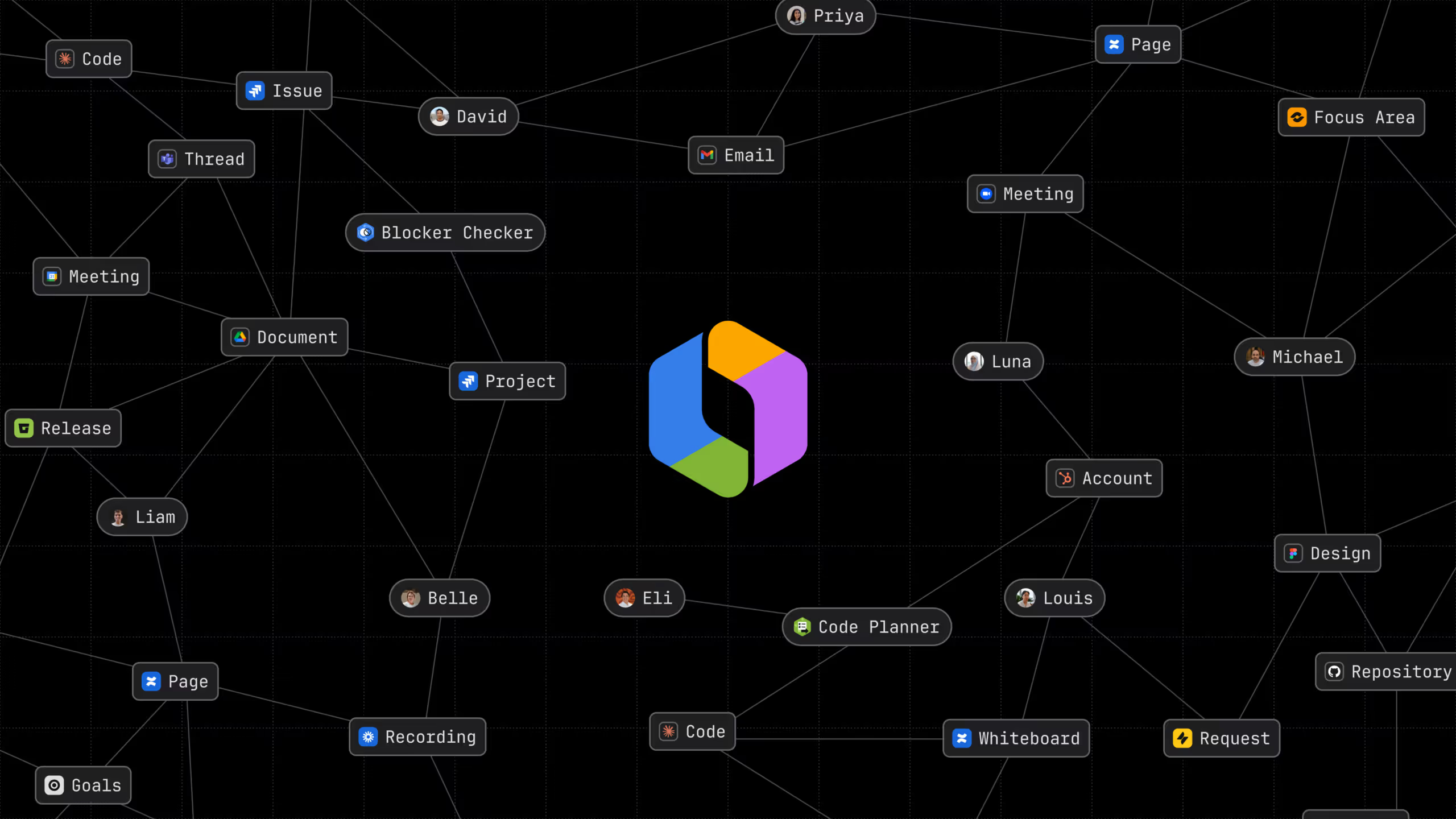
Atlassian's Teamwork Graph - the unified map of relationships between work, people, knowledge, and decisions inside an organisation - now spans more than 150 billion connections, according to figures shared from the main stage. That graph has been quietly powering Rovo for the better part of a year. What changed at Team '26 is who gets to read from it.
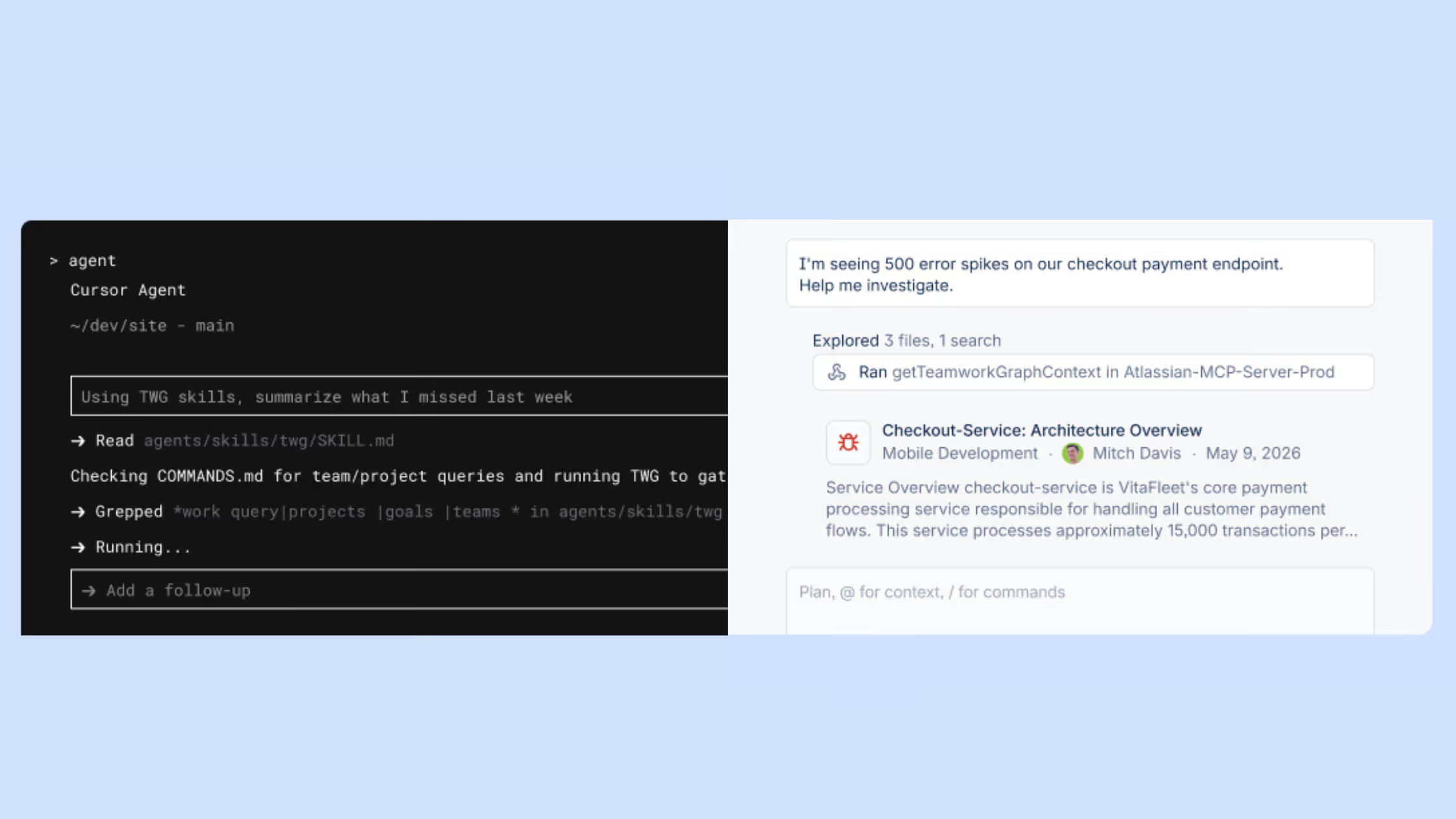
Atlassian announced the broad opening of the Teamwork Graph through two new interfaces, both in open beta. A Teamwork Graph CLI gives developers programmatic access to the graph from local tooling and CI pipelines. Teamwork Graph tools delivered through Rovo's Model Context Protocol (MCP) server expose graph context to third-party agents over an open standard.
It's a meaningful repositioning. For most of the last decade, Atlassian's pitch has been variations on "the place where work lives." The pitch in Anaheim was something different: the context layer that other AI systems plug into. NAND Research framed it as "context as infrastructure", and that's roughly the right way to read it.
The practical implication for buyers is worth sitting with. If you've been treating Jira, Confluence, and Rovo as a vertical stack, you may want to start thinking of them as the horizontal substrate underneath whatever agent ecosystem you build out over the next year. The shift from "buying a tool" to "extending a graph" is subtle in the slides, but it changes the procurement conversation.
Rovo grows up - from helper to agent
A year ago, Rovo was largely positioned as a smart assistant: search across your tools, summarise a page, draft a Jira ticket. At Team '26, Atlassian made it clear that framing is over.
The numbers came first. Cannon-Brookes told the crowd that more than 90% of Atlassian's enterprise cloud customers are now using Rovo in some form, and that agentic automations across the customer base have grown roughly 7× in the last six months. Whether or not those figures hold up under analyst scrutiny, the directional claim is hard to argue with: this is a feature people are actually running, not a demo loop.
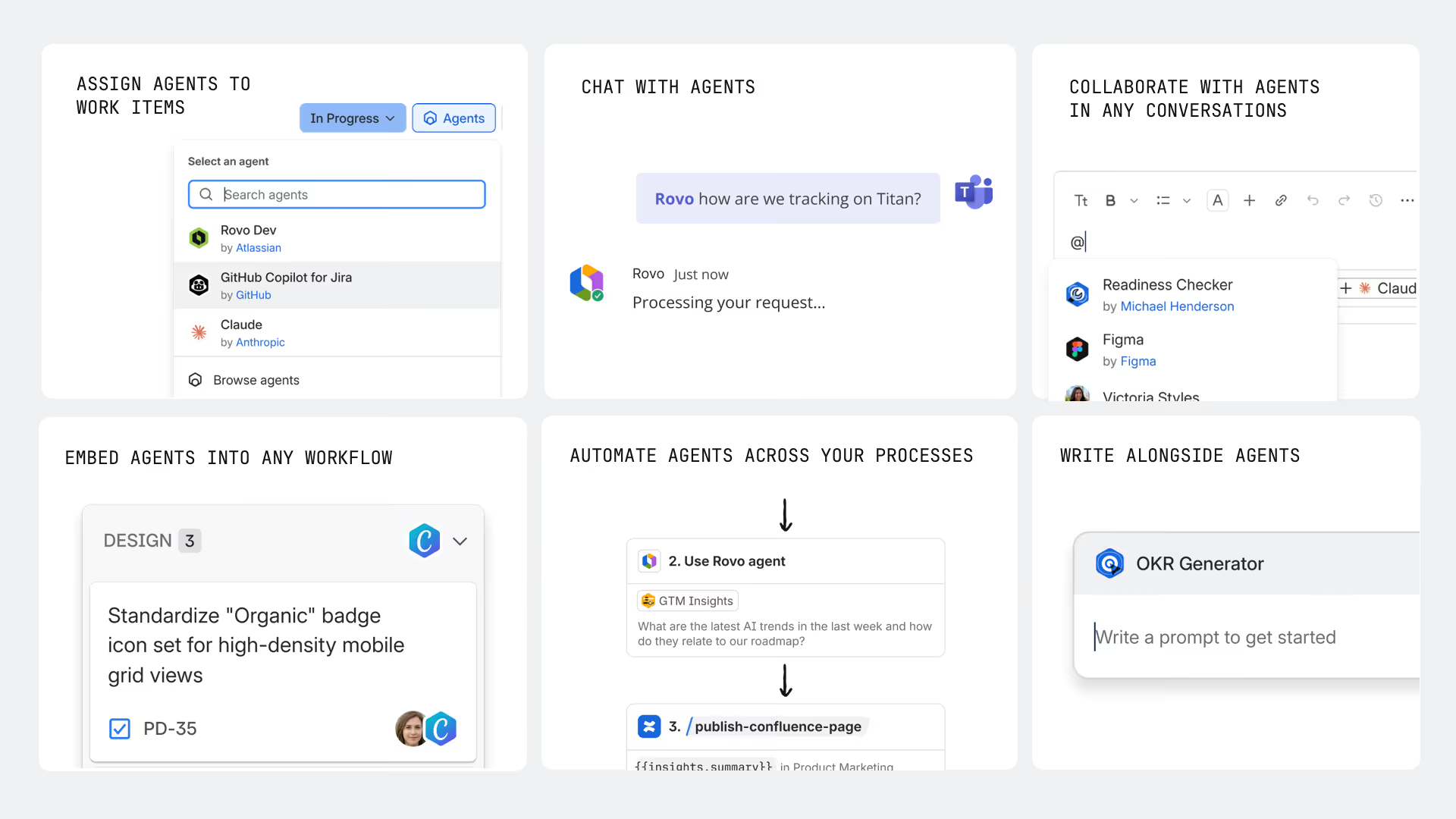
The product news matched the framing. Agents in Jira are generally available. They can be assigned work items the same way you'd assign a human, with full audit logging behind every action they take - a detail aimed squarely at compliance and security teams who have spent the past year asking the right questions. A new "Max mode" for Rovo Chat, sitting one step up from conversational chat, lets users hand off multi-step tasks to agents that coordinate actions across Atlassian and connected SaaS applications. And Third-Party Agents in Confluence went to open beta, meaning you can now @mention agents from partners like Lovable, Replit, Databricks, and Gamma directly inside a page, the same way you'd tag a teammate.
The shift in posture is the story here. Rovo isn't being pitched as a helper anymore. It's being pitched as a coworker - one with login credentials, an audit trail, and an inbox.
What's new in Jira
Beyond Agents in Jira reaching general availability, two announcements stood out for the Jira faithful.
Jira Product Discovery Enterprise hit general availability with portfolio-level governance baked in. The previous version of JPD was usable but stopped short of what large product organisations actually need: consistent intake, scorecards, and roadmap rollups across dozens of product teams. The Enterprise tier closes a lot of that gap, and several talks across the conference framed it as Atlassian's serious bid for the Productboard / Aha! / Roadmunk segment of the market.
The other quieter announcement was a new Feedback capability in early access, designed to capture customer signals at the point of intake rather than as a separate research workflow. Combined with the discovery features in JPD, it's clear Atlassian is trying to close the loop between "what customers told us" and "what we put on the roadmap" inside a single product.
For day-to-day Jira admins, the practical near-term implications cluster around governance. More agents acting on issues means more configuration around what they can and can't do. Expect permission schemes to be the next thing your security team asks about.
What's new in Confluence
The single feature that drew the most audible reaction in the main hall was Remix with Rovo, currently in beta. The pitch: highlight any text, table, or list in a Confluence page, and turn it into a chart, slide deck, infographic, or database - without leaving the page.
That's a bigger deal than it sounds. Confluence has historically been a destination - somewhere you go to read or write a document. Remix nudges it toward being a surface - something you act on, transform, and pull other artifacts out of. The boundary between "page" and "asset" gets blurry in a useful way.
Remix with Rovo is great for fast fixes and one-off tidyups. If your team needs reliable, repeatable page structure and the ability to include raw HTML where necessary, Capable Studio is the next step. Its formatting-first toolkit lets you create reusable, editable macros (cards, banners, callouts, code blocks), lock design rules, and push updates across pages without rework; developers can insert HTML when they need pixel-perfect control while writers focus on content.
The other Confluence headline is Third-Party Agents (covered above), which lands at exactly the same conceptual point. Pages are no longer just places where humans collaborate with each other. They're places where humans collaborate with humans and with the agents they choose to invite in.
If you administer a large Confluence estate, the operational question this raises is governance: which third-party agents are allowed in your space? Who decides? How are their actions logged? Atlassian gestured at the answers without fully landing them, which means the hard work of policy will land on admins. Worth thinking through now.

Service Collection and the AI-era ITSM story
Atlassian's third major announcement is a new bundle and a new posture: Service Collection, described from the stage as "more than a bundle - Atlassian's service fabric for the AI era." It pulls Jira Service Management, Rovo Service, and a handful of newer capabilities under one commercial and conceptual umbrella, aimed at customer support and employee service teams.
Two pieces inside it are worth pulling out. The new Incident Command Center unifies incident detection, investigation, and resolution into one workflow. Crucially, it leans heavily on Rovo for assisted root-cause analysis - pulling context from across the Teamwork Graph to suggest probable causes and surface related incidents from the past. For SREs and ITSM leads, this is one of the more concrete demonstrations of what an open graph actually buys you.
Rovo Service offers autonomous or supervised Level 1 support. The supervised mode is the interesting one: an agent drafts a response and a human approves it, which is a much easier sell to a service-management leader than full autonomy. Expect that to be the dominant deployment pattern for at least the next 12 months.
For JSM customers, the read is that Atlassian wants ITSM to be a flagship AI category, not a side product. For the broader ITSM market, the read is that the competitive surface area just expanded.
The customer moments worth replaying
If you missed the keynote, the talk to find on replay is Magnus Östberg, Chief Software Officer at Mercedes-Benz AG. Östberg walked through how the company moved from AI novice to what he called "AI native" - and the most honest moment of the talk was his admission that the technology was rarely the bottleneck. Change management, organisational design, and the willingness to let agents own outcomes were.
That theme echoed across customer talks throughout the conference. Docusign spoke about embedding Rovo agents into their internal workflows and the unexpected cultural friction that came with it. Teach For All described how a small operations team uses Rovo to coordinate work across dozens of independent country partners - a use case that mostly didn't involve software engineers at all.
If there's a pattern across the customer track, it's this: the organisations getting real value out of Rovo and Agents aren't necessarily the ones with the most sophisticated technical stack. They're the ones whose leadership has actively redesigned roles, responsibilities, and review processes to account for non-human colleagues. The platform is necessary. It is, on its own, not sufficient.
The announcements that flew under the radar
A few things didn't get top billing but matter, depending on where you sit.
The Marketplace revenue share update is the big one for partners and developers. Effective January 1, 2026, Forge developers pay 0% revenue share on the first $1M of lifetime Forge earnings. For the partner ecosystem - increasingly the connective tissue between Atlassian and the long tail of customer needs - it's a meaningful realignment of incentives toward Forge-native builds.
Dia Reports got a quieter slot but is worth flagging. The new product generates proactive, browser-native briefings - interview prep documents, decision memos - by combining Teamwork Graph context with everyday browser activity. Easy to miss; harder to forget once you've seen the demo.
And finally the Teamwork Graph CLI deserves a second mention. Buried inside the graph-opening announcement, it's the first time developers can poke at the graph from outside Atlassian's own tooling. Expect interesting community projects to follow.
Capable - Atlassian Partner Awards Finalist
A small note from us before we wrap up. In the lead-up to Team '26, Capable was named a finalist for the 2026 Atlassian Partner Awards in the Cloud Transformation Apps category, alongside Appfire and Tempo. Being mentioned in the same breath as two of the Marketplace's most established partners is humbling for a team our size, and it reflects a year of work helping customers move more of their day-to-day onto Atlassian Cloud. Our thanks to the Atlassian Marketplace team - and to every Capable customer who got us here.
.avif)
Where this is all heading
Step back from the individual announcements and a coherent argument emerges. Atlassian is making three bets in parallel, and each one reinforces the others.
The first bet is on context - that the value of an enterprise AI system is determined less by the model and more by what it knows about your work. The Teamwork Graph is the manifestation of that bet.
The second bet is on openness - that no single vendor will own the agent ecosystem, and that the platforms that win will be the ones agents come into, not the ones that try to keep them out. The MCP server, the CLI, and Third-Party Agents in Confluence are all the same idea wearing different jackets.
The third bet is on agents-as-coworkers - not as features, not as plugins, but as colleagues with seats at the table. Whether that bet pays off won't be visible at Team '27. It'll be visible in 2028, in the org charts of the companies that took it seriously this year.
For now, the only definitive verdict from Anaheim is this: the platform you were administering at the start of 2026 is not the platform you'll be administering at the end of it.
Further reading
- Atlassian Team '26: Meet the AI-Native Organization - Inside Atlassian
- Atlassian opens Teamwork Graph and pushes Rovo into agentic execution at Team '26 - SiliconANGLE
- Built for the Next Era of Teamwork: What's New in Teamwork Collection - Inside Atlassian
- Atlassian Team '26: Context as Infrastructure - NAND Research
- Atlassian Team 26 - From AI novice to AI native - Diginomica
.avif)




%20(800%20x%20200%20px).avif)